Apparently We're Not Perfect Yet!
Why asking for feedback is important!
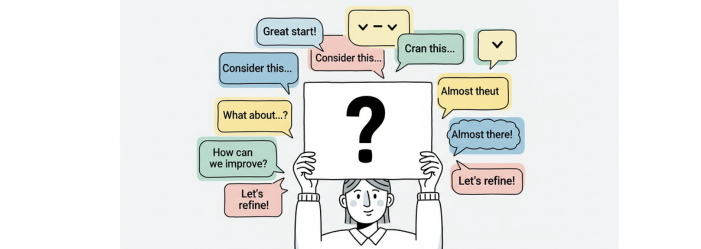
There's a question that makes many people cringe when they hear it, And it's this: “Can I offer you some honest feedback?”
I must admit, I don't particularly enjoy receiving feedback, but I've learned how valuable it can be. One of the great revelations in life is when we realize that most people don't see us the way we see ourselves. Very often we're very kind in our opinion of ourselves, although sometimes it's the opposite, and we have a much more negative view of ourselves than the rest of the world. Either way, we are seldom 100% accurate in our self-awareness.
But the whole fallacy of not liking feedback implies that we are somehow perfect already. We don't want people to think that we have flaws or that we make mistakes, which is a little crazy. Or maybe just human. In actuality, we don't expect anyone else to be perfect, and we expect people to make mistakes. We hope that they acknowledge that they're making a mistake, even though we very often resist acknowledging our mistakes ourselves.
The reason I have embraced feedback is because one of my goals in life is to always be getting better, better at speaking, at writing, at communicating, at being in a relationship, at being a friend, and at being a business advisor.
I want to get better at all these things. And yes, of course, I can take video courses and read self-help books and get all sorts of safe input, but many times, the most valuable feedback is from someone who observes you in action.
I recently was in a two-day workshop, working on my speaking skills, because I was determined to get significantly better this year. I would watch videos of myself and couldn’t see what was wrong. And I secretly suspected I wasn’t perfect!
The first hour into this workshop, I learned half a dozen things that I could improve, all because I willingly subjected myself to painful feedback. (I also believe that if the feedback isn’t painful then they’re not being honest with you!)
And here's the cornerstone of feedback: you have to trust the source.It has to come from someone you respect, and it also has to come from someone who doesn't have an ulterior motive. It needs to be somebody who has your best interest at heart.
Let me make a clear distinction between feedback and unsolicited advice. Another term for unsolicited advice is unwelcome advice. It’s not feedback, but comes in that disguise. More about that in another newsletter.
The pure intent of feedback should be constructive. There is no chastising element to feedback. Also, let's forget about the whole “criticism sandwich,” where you give praise, then criticism, then praise again. Everybody's gotten wise to that.
Feedback is also something that needs to be accepted. Otherwise, it’s unsolicited advice. For example, my coach would often ask me, “Can I offer you an insight?” That's a really great question, because it requires me to say yes. I have the opportunity to say, “No, I'd rather not hear your insight.” But if I give permission, then I have to listen.
An interesting example of powerful feedback in my business career was when we were doing a 360 Evaluation with our VP and executive team back when I was CEO of 1-800-DENTIST. This is a process where everyone writes anonymous feedback about everyone else, and then it's compiled and, if it's consistent, let's say 60 or 70% of the people said certain things about another person, then it is considered useful feedback, and you would get to read it. It turned out that one of the things my team agreed on was that I shoot the messenger. I was very surprised at this, and said so. And my COO looked at me and said, “Seriously? You don't know this about yourself?”
I reflected on it, and when I started playing back specific conversations, I saw that I indeed did do that.
I don't do it anymore. I got better because I got feedback about something that I really didn't know about myself.
It takes boldness to ask for feedback, just as it takes boldness to offer it. Keep in mind, if you want to offer feedback, remember how much you don't like it yourself, but realize that, if it is constructive, then it is an act of kindness. Also, you could preface your feedback with, “I might be wrong. This is just how I see it.”
We all need to get better at being a leader, a team member, a partner in a relationship, and a citizen of the world.
Finally,if you don't want to get better, well, I have some feedback for you.
This Week's Boldness Exercise:
Your boldness exercise this week is to ask at least three people for some feedback about your work performance, and then do the same with a good friend and your significant other.
You could simply ask, “Where do you think I could improve?” or, “What do you think I’m not aware of?”
And with your significant other, if you’re feeling bold, you could ask, “What is it I do that really bothers you?” And then stop doing it!
About Fred Joyal
Fred was the co-founder of Futuredontics, the parent company of 1-800-DENTIST, which, over 30 years, generated over $1 billion in revenue. His latest book, Superbold: From Under-Confident to Charismatic in 90 Days, is an Amazon and Wall Street Journal bestseller. He is also the author of two books for the dental industry, Everything is Marketing: The Ultimate Strategy for Dental Practice Growth, published in 2010, and Becoming Remarkable: How to Create a Dental Practice Everyone Talks About, published in 2015. He has acted in, written or directed over 200 television commercials and radio spots. Learn more about Fred by visiting his webpage online.