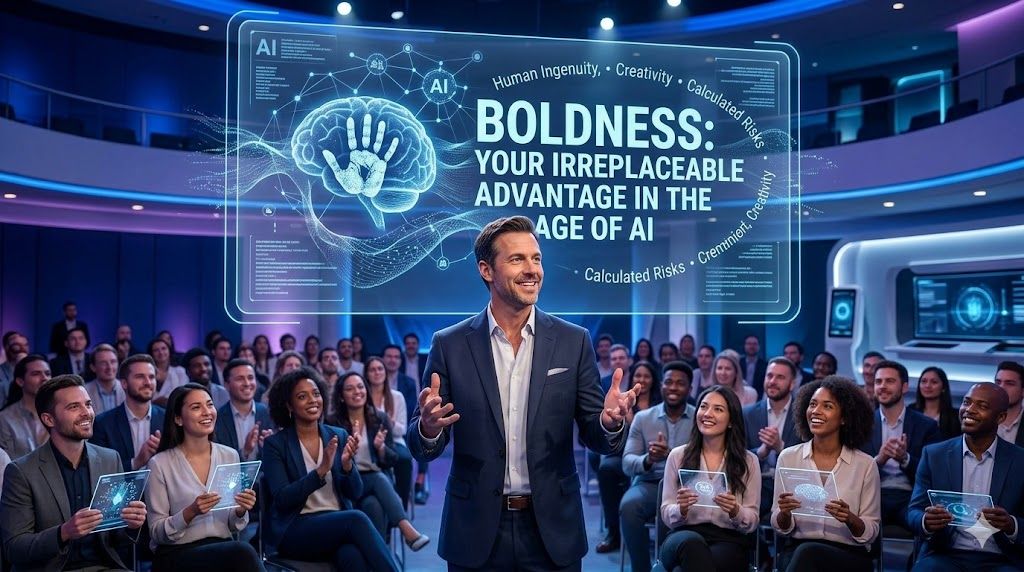
Boldness: Your Irreplaceable Advantage in the Age of AI
Why Boldness Will Be Your Only Durable Skill in an Unpredictable World
In 1910, there were almost 300 automobile companies in the US. By 1950, there were three.
This is what technological disruption does, over and over again. It creates explosive opportunity while radically lowering the barrier to entry. It attracts capital, dreamers, engineers, and optimists. And then it consolidates.
We are living in the 1910 moment of AI. But it’s not going to take 40 years this time.
New AI companies are forming daily. Entire job categories are being automated. Business models are being rewritten in real time. And here’s the uncomfortable truth: no one can credibly predict what their career, their company, or their industry will look like in five years. Anyone who claims they can is guessing.
I’ve lived through disruption myself. In fact, in my own small way, my partner and I totally disrupted dental practice marketing with our company 1-800-DENTIST. The company operated for 25 years and generated, in aggregate, over a billion dollars in revenue. For most of that time, our model was stable and profitable. Then Google became a major competitor, and the decline began. Our pivots were incremental and didn’t forestall the inevitable.
If we were starting that same business today, incorporating AI, it would look radically different. Back then, we needed 100 telephone operators working 24/7, 365 days a year to operate the call center. Today, AI could handle the overwhelming majority of those interactions. We might need five human operators stepping in only when AI couldn’t fully satisfy someone. That one shift would have changed our profit model from an EBITDA of 15% to 60% or more.
For decades, entrepreneurs built businesses with 10-year horizons. Venture capital firms funded companies expecting liquidity events five to seven years down the road. Today, that kind of predictability feels almost naïve. If a founder confidently pitches a 10-year run to their new enterprise in this environment, the conversation won’t last long. The pace of AI acceleration makes long-term certainty nearly impossible.
So the question is no longer, “What business model should I build?” It becomes, “What core capability will allow me to survive multiple business models?”
I recently spent a day at Boston College, one of my two alma maters. I mostly chatted up students around the campus. The number one question students asked me was, “What was your major?” What they were really asking was, “What should I study so I don’t become obsolete?”
I realized they had become aware that almost nothing they studied guaranteed a job when they graduated, never mind a career. Ten years ago, it was estimated that the average college student would have five entirely different careers over their lifetime. Imagine that projection now. Assuming they will most likely live comfortably past 100 years old with the advances in medical science, and very likely won’t have Social Security benefits (unless they don’t start paying until you’re 90!), then graduates today could have 20 careers or more.
Their ability to pivot won’t be optional. It will be survival. They will have to unlearn more than they ever learned in college. Any business you create today will need to adapt to serve a marketplace that will significantly change in five years. A need you satisfy right now profitably could not even be necessary, or will be handled by a robot, AI or a tenth of the humans it requires now.
So what skill becomes the irreplaceable advantage? Certainly not coding. That’s changing almost monthly. Not prompt engineering. And would you want to be a camera operator right now? Or an ad agency? We ran primarily television ads to promote our business, and were very efficient, producing spots at a cost of $20-25,000 each. In two years, the average cost of a TV spot will be less than $200. (Look, even I can’t resist predicting the future!)
What I’m telling the executives I advise, as well as college students, is that the core skill will be boldness. That may seem strange, but boldness is one of the primary drivers of success, in my experience. And AI is going to have trouble learning it. But what I discovered is that boldness can be learned, despite most people thinking that it’s a personality trait.
Let me be clear about something. Boldness is not the same thing as confidence. Confidence is how you feel. It’s situational. There are rooms where you feel confident and rooms where you don’t. Boldness, on the other hand, is all about action. It’s the willingness to move forward without certainty, to take risks knowing it could easily go wrong. And the willingness to make decisions without having all the information.
In an environment where clarity no longer exists, boldness becomes the deciding human element determining your long-term success. Because change is coming faster than humans have ever experienced, and that will imbalance many people. And they will be hoping and praying for Universal Basic Income.
Many companies will fail not because AI replaces them overnight, but because they won’t acknowledge that their model is almost over. They will overplan. They will protect sunk costs. They will delay difficult pivots and try to incorporate AI in ways that won’t matter in the short run, never mind the long run. They will hope stability returns (How crazy does that sound?)
Stability is no longer the default. You may need to abandon 90% of your business model two years in. That takes boldness.
As AI takes over more routine and even complex tasks, something else rises in importance: human interaction. I’m talking about real interaction, face-to-face. Not on Zoom.
Your ability to walk into a room and connect, to communicate your ideas clearly and persuasively to an individual or 2000 audience members, will be the most versatile skill you develop. Your ability to influence spontaneously, to engender trust, to inspire confidence in your versatility and adaptability, those things are what will get you the investment capital to realize your vision. Not a detailed spreadsheet or an AI-designed presentation.
AI can generate words, projections, code, images and video. But it cannot generate presence. It cannot generate conviction. And if it feels charismatic, it’s faking it.
But your own charisma, contrary to popular belief, is developable. Because charisma is simply bringing your full self to the world, projecting that you belong wherever you are. You can learn that. We are drawn to people who are authentic, energetic, enthusiastic. It’s magnetic. We admire it. And it will open doors you never even knew existed.
There is a longstanding sales aphorism that people only buy from people they like. In the world of online purchasing we live in now, most buying doesn’t even require a human. And that will be more true every month, whether it’s ordering your Starbucks or buying your new electric sports car.
But many things will need to be sold, important things that we need to be persuaded to spend money on. For that, you don’t just need people to like you. They need to be charmed by you.
Once you develop your boldness, daily, steadily, it will evolve into charisma, simply because you will naturally project that you belong wherever you are, convince people you are capable of leading through uncertainty, can admit you’re wrong, and have much more to learn, but are eager to do so. As a result, you will be staying ahead of the curve that is becoming a tidal wave.
If you haven’t noticed, there already is a counter-reaction to AI’s pervasiveness. I think this will become part of our transition into a very different future, where AI dominates in some areas, and doesn’t exist or is restricted in others.
I’m already seeing media platforms restrict AI-generated content. Publications are rejecting submissions created by AI. Whether they can detect it perfectly in two years is almost beside the point. The bigger issue is this: if you rely on AI to think for you, structure your ideas, and express your voice, you are dulling your ability to create, and more importantly, to connect. You are outsourcing your edge. And the more you outsource that muscle, the weaker it becomes.
When I tell people they need to develop their boldness, they often respond by saying, “I’d be bolder if I were more confident.” But they have it backwards. Confidence doesn’t create boldness. Bold action creates confidence. When you take action, especially when the stakes are low, you build the boldness muscle. You expand your comfort zone. You teach your nervous system that risk is to be embraced, not avoided.
That’s called resilience. And that’s what you’re going to need most to chase your dreams.
When I was building my business, the stress ramped up gradually. Today, businesses scale faster, fail faster, and pivot faster. Resilience has to ramp up just as quickly. Yet I see more overplanning, more perfectionism and, worst of all, more avoidance of discomfort. Social media doesn’t build boldness; it builds a curated and false sense of safety. But the AI era will reward those who are comfortable being uncomfortable.
If you’re not regularly doing things that stretch you, your world is shrinking. Your tolerance for stress decreases. Your confidence diminishes when it needs to be expanded. And in a rapidly shifting environment, that is dangerous.
I recommend something simple: do uncomfortable things when the stakes are low. Start conversations with strangers. Be the one who speaks up in meetings. Ask questions instead of giving advice. Be curious, more curious about people than what’s scrolling on Instagram. Seek feedback on your weaknesses. Try presenting before you feel ready. Admit ignorance and be mindful of your confirmation bias. Change your mind, and do it publicly and regularly.
This is what I call doing reps to build your boldness muscle. The growth will happen, and you will feel your comfort zone expanding, and trying and failing will feel better than not trying. And, when it matters most, instead of cautiously hesitating, you’ll find that stepping up, saying yes, taking that chance, will be your reflexive response.
Most people believe they can think their way into being more confident. That’s not how the brain works. You act your way into a new way of thinking. The bold people I’ve emulated didn’t wait to feel ready. They took risks. They failed. They adjusted. They built resilience. They expanded their comfort zone until almost nothing felt off-limits.
That’s the Boldness Advantage in the modern age. That’s how you will futureproof yourself. AI will write faster, code faster, design faster, automate faster, and analyze faster. But it cannot walk into a room and build trust. It cannot make a decisive human judgment under pressure. It cannot lead people through ambiguity.
We don’t know who the eventual “Big Three” of AI will be. We don’t know which jobs will survive or which industries will shrink. The only thing we know is that it’s moving faster than anything before it.
If you do not develop your interpersonal boldness, your resilience, and your tolerance for discomfort, you are on a path to obsolescence. That may sound harsh, but it’s the truth. The exciting part is that it has never been easier to practice boldness. As so many people are hesitating, hiding in their phones, sitting in their apartments getting food delivered, you can go out into the world and master human interaction.
And it will serve you well all of your days.
Your Boldness Exercise for the week:
Do something that scares you this week. It could be singing Karaoke or asking for a raise. You come up with it. Then do another one!
About Fred Joyal
Fred was the co-founder of Futuredontics, the parent company of 1-800-DENTIST, which, over 30 years, generated over $1 billion in revenue. His latest book, Superbold: From Under-Confident to Charismatic in 90 Days, is an Amazon and Wall Street Journal bestseller. He is also the author of two books for the dental industry, Everything is Marketing: The Ultimate Strategy for Dental Practice Growth, published in 2010, and Becoming Remarkable: How to Create a Dental Practice Everyone Talks About, published in 2015. He has acted in, written or directed over 200 television commercials and radio spots. Learn more about Fred by visiting his webpage online.